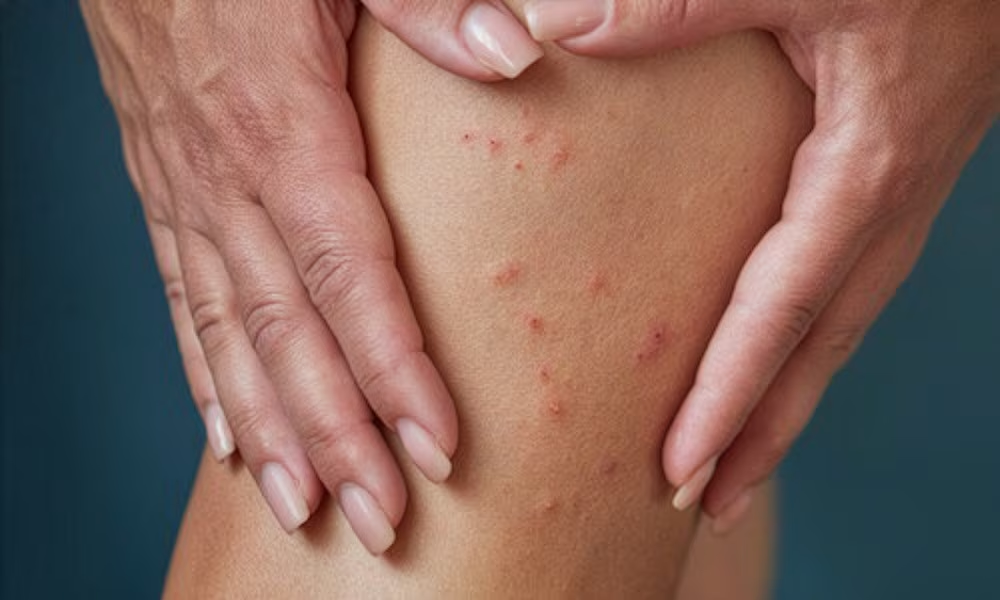
Scabies is a highly contagious skin condition caused by the microscopic Sarcoptes scabiei mite. These mites burrow into the skin, leading to intense itching, irritation, and a distinctive rash. Although common, scabies should never be ignored — early diagnosis and treatment help prevent complications and stop the infection spreading to others.
Scabies develops when female mites burrow into the upper layers of the skin to lay eggs. The body reacts to the mites, their eggs, and their waste — causing:
Scabies is not related to poor hygiene. Anyone can catch it — including children, adults, and the elderly — regardless of lifestyle or cleanliness.
The only direct cause of scabies is infestation with the Sarcoptes scabiei mite. These mites thrive in warm areas of the body and reproduce within the skin.
These can carry mites for up to 2–3 days.
Most people notice symptoms 2–6 weeks after first exposure — but in people who have had scabies before, symptoms can appear within a few days.
In infants and elderly patients, the face, scalp, palms, and soles can also be affected.
You can contract scabies through:
Because symptoms take weeks to appear, a person may pass scabies on before they realise they’re infected.
Yes — to prevent spreading the infection.
Everyone in the household and close physical contacts should be treated at the same time to prevent reinfection.
Scabies requires prescription treatment — it will not clear with home remedies.
Creams such as Permethrin 5% are applied from the neck down and left on for 8–12 hours.
Given in cases of severe, crusted, or persistent scabies.
Even after successful treatment, itching may continue for 2–4 weeks due to the body’s allergic reaction. Relief options include:
Even if they have no symptoms — this is essential to avoid reinfestation.
Scabies remains contagious until treatment has been completed. After starting the correct medication, people are usually no longer contagious within 24–48 hours, although itching may continue longer.
You should see a private GP or dermatologist if:
If untreated, scabies can lead to:
Early diagnosis prevents these complications.
Yes. Scabies is fully curable with the correct prescription treatment. The most common first-line therapy is Permethrin 5% cream, which kills the mites and their eggs when applied properly. In some cases—such as severe, crusted, or persistent scabies—oral Ivermectin may be prescribed.
Even after successful treatment, itching may continue for 2–4 weeks due to the body’s allergic reaction to the mites, but this does not mean the infection is still active. To ensure complete cure, all close contacts must be treated at the same time and all hygiene steps must be followed.
Yes. Scabies mites can survive away from the human body for up to 72 hours. During this time, bedding, clothing, and towels can remain contagious.
To prevent reinfestation:
These steps help ensure mites and eggs are completely destroyed.
Yes — scabies spreads very easily and often before symptoms appear. It is most commonly transmitted through prolonged skin-to-skin contact, such as between family members, partners, or people living in shared accommodation.
Because symptoms may take 2–6 weeks to appear after the first infection, a person may unknowingly pass scabies on to others.
Even individuals without symptoms must be treated to stop the infection cycle.
Scabies can be spread through sexual contact, as prolonged close skin contact makes transmission more likely.
However, scabies is not classified as a sexually transmitted infection (STI). It can be passed between any individuals in close physical contact — including family members or children — not just sexual partners.
Scabies can be distressing, uncomfortable, and easily spread — but early treatment stops it quickly.
At Private Medical Clinic, we offer:
Your health doesn’t need to wait — and neither should your treatment. Book your scabies consultation today.
Dr. Ibrahim Mutlib (BMBS, BMedSci) is an experienced GP with specialist interests in mental health, gastrointestinal health, and respiratory medicine. A clinical leader and published author, he is passionate about innovative, patient-centred care that supports both physical and emotional wellbeing.